MARCH AGAINST THE MACHINES
March 08, 2026 by Extinction Rebellion
A pause before we build
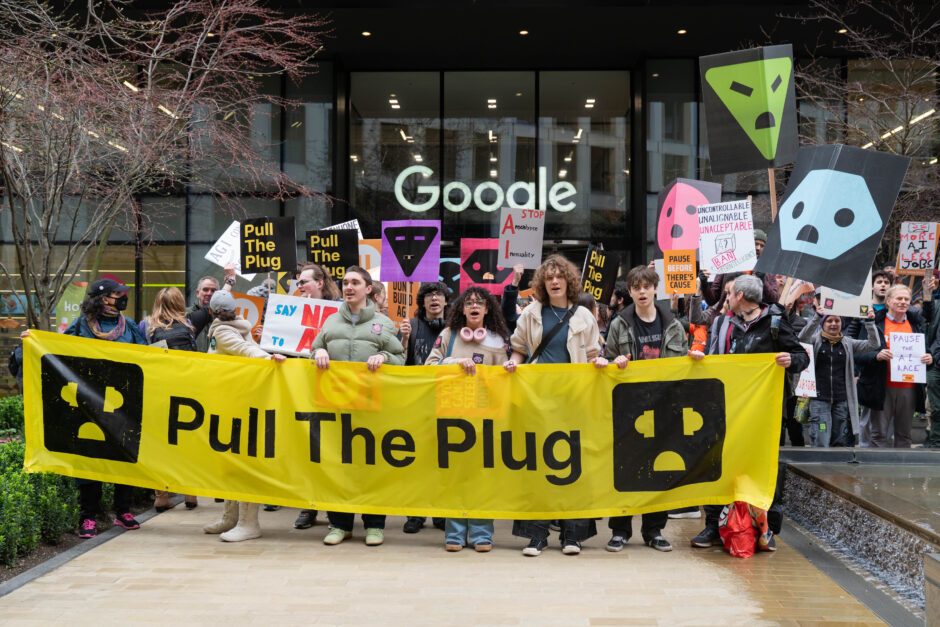
Last Saturday, 28 February 2026, I marched through central London with thousands of other people in the biggest ever protest about the use of AI.
This march was organised by young people and it showed in the energy of the day. Pull The Plug teamed up with Pause AI and Mad Youth Organise.
I was there as an Extinction Rebellion media volunteer, but I was also there as a mother and a creative worker who relies on technology for my job.
The placards weren’t anti-technology. They weren’t calling for the lights to be switched off or the plug to be pulled on everything new. The feeling was more thoughtful than that. Slower. A collective intake of breath.
We were asking for a pause.
Not because the technology itself is inherently evil. But because the pace of development feels completely disconnected from any meaningful public conversation about what it is for, who it serves, and what it costs — environmentally, socially and democratically.
Again and again the same concerns came up in conversations along the march.
Some people were worried about nature — the energy and water demands of vast data centres and the extraction needed to power them in the middle of a climate and ecological crisis.
Others spoke about something harder to name but deeply felt: a loss of control. Systems appearing in workplaces, schools and public services before anyone has really asked whether we want them there, or how they should be governed.
And many people were worried about their livelihoods. Teachers, artists, programmers, writers — people wondering what happens when powerful automation arrives faster than society can adapt.
But beneath these concerns sat a deeper question.
Not simply ‘what will AI do?’
But ‘who will control the infrastructure that builds and runs it?’
The data. The rules. The direction of travel.
And that matters not only for democracy, but for creativity too. Many people in the crowd weren’t rejecting AI. They were imagining tools that expand human creativity rather than systems quietly managing our lives. But that future depends on who controls the infrastructure that builds and runs these technologies — and whether the public has any say in how they are governed.
One conversation from the front of the march has stayed with me. I was walking near the stewards, chatting as we moved slowly through the streets, when a man in his thirties fell into step beside us. He hadn’t come with the march. He had simply seen it passing and was curious. He asked what our demands were. Why were we marching?
Then he asked a harder question.
“What are your biggest fears with AI?”
I paused. It’s surprisingly difficult to answer that directly. Part of my mind went immediately to the darker edges of it all — the way AI is already being used in warfare and surveillance, and the sense that systems of enormous power are being built faster than society can properly understand or govern them.
But that’s not always the easiest thing to explain to a stranger in the middle of a march. So I started with something more tangible. I told him about the infrastructure behind it — the vast data centres needed to train these systems, their energy use and the water required to cool them.
I told him that I worry about nature. But I also worry about creativity. About freedom. About who gets to shape the systems that will increasingly shape us. He asked whether I was worried about jobs for my son when he grows up.
I told him honestly that young people tend to be far more adaptable than we give them credit for. They grow with technology. They reshape it. They find paths older generations couldn’t imagine. But then he laughed slightly and admitted he was worried about his own job.
He’s a lawyer, and he uses AI every day to draft legal documents. “It writes better than me sometimes,” he said. There wasn’t anger in his voice. Just uncertainty — the quiet realisation that the ground beneath his profession might be shifting. He was thoughtful, curious, open. Before we parted, we agreed it felt important for society to be talking about these questions now, rather than later.
Not a call to smash the machines.
But a simple democratic request: pause long enough for people to decide together what we are building.
This is bigger than which chatbot we use or which AI company claims to be the most ethical. Individuals can’t shop their way out of this structural problem.
We’ve seen this playbook before. BP first marketed the idea of the “personal carbon footprint”, shifting their responsibility onto individuals.
The truth is that OpenAI, Anthropic, Google, Microsoft, Nvidia all have defense deals meaning there is no clean option. None of their power depends on your subscription anyway. These companies aren’t valued on your monthly fee. They’re valued on pentagon contracts and sovereign wealth funds. Tech giants and authoritarian governments are not just tolerating each other, they are co-investing.
After the march, people gathered for exactly the kind of conversation they had been calling for. We shared hot vegan food and warm drinks, then held an assembly to talk about fears, hopes and safeguards.
For me, moments like that matter.
Protests push hard for change, but they also create space for reflection, care and listening. Sharing food and talking openly about the future we want is a small way of modelling the world many of us want to build..
Extinction Rebellion has always tried to hold that balance: pushing urgently for change while practising regenerative ways of relating to each other.
The message of the march felt closely aligned with XR’s three demands.
Tell the Truth about the risks and consequences of these technologies.
Act Now to ensure strong safeguards before systems become too powerful to regulate.
Decide Together through democratic participation, such as citizens’ assemblies, how AI should be governed and where its limits should lie.
The same concentration of power — in technology, fossil fuels, the military, finance and media — lies behind many of the crises we face. Wealth and decision-making are increasingly concentrated in the hands of a few corporations and billionaires, while division and scapegoating distract from the systems driving climate breakdown and inequality.
This is also why Extinction Rebellion UK will be joining the Together Alliance march on 28 March. XR has always been non-partisan, and this is not about regular left versus right-wing politics. It is about recognising that climate justice, racial justice, migrant justice and democratic accountability are deeply connected. The same extractive, individualistic system threatens all of our safety and freedom. This march will bring together workers, migrants, climate activists and communities from across the UK — including a cultural procession from Notting Hill Carnival and a wide range of musicians and DJs playing in Trafalgar Square until 6pm. It will be a moment of celebration and solidarity, reminding us that the future should not be written for us, without us.
The most meaningful thing you can do in 2026 is find discussion spaces and groups in your local area or online who are already organising nonviolent direct action and building community resilience.
A better world is already being built. Everyone is welcome.
Feature photograph by Denise Laura Baker
Pull The Plug
“Give ordinary people a real say in how AI is used in our lives.”
Pause AI
“We mobilise communities, challenge industry, and press leaders to pause unsafe AI development until real safeguards exist.”
Mad Youth Organise
“Fighting the corporations getting rich while we get sick.”
Together Alliance
“Our members represent over 7 million people.
We are teachers, firefighters, care workers, cleaners, midwives, engineers and so much more. We’re all marching for unity against division.”