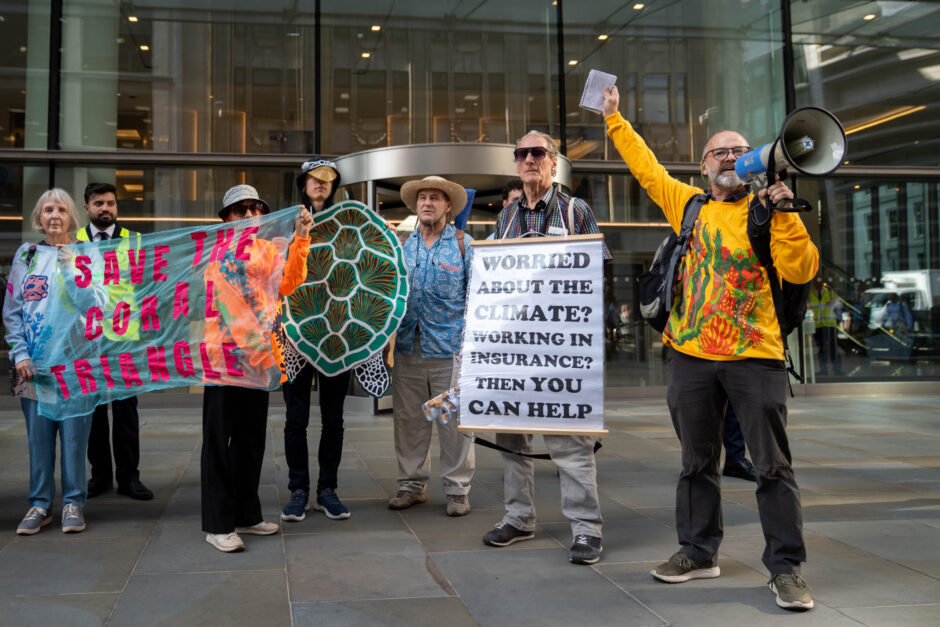
Activists Occupy Major Insurer’s Foyer in Coral Triangle Biodiversity Action
August 11, 2026 by Extinction Rebellion
Photos & videos: Download here from 10am
Media contact:
Blythe Brentnall
Boycott Bloody Insurance
blythe@boycottbloodyinsurance.org
[LONDON — Tuesday 11th September 2026]
Corporate spies hired by the insurance sector are tailing peaceful protesters, it emerged today, with two arriving at the protesters’ meeting point and taking photos of the activists who aimed simply to highlight the grave threats posed by insuring liquefied natural gas expansion in the highly sensitive area of marine biodiversity of the Coral Triangle. The two corporate spies have been identified at previous protests, telling activists that they have a WhatsApp chat of all known protesters against the insurance sector.
The activists intended to stage a peaceful protest in the Walkie Talkie foyer, which went ahead outside the building instead. Dressed in artistic costumes they depicted the extraordinary biodiversity of the Coral Triangle, in a call for insurers to rule out underwriting liquefied natural gas (LNG) expansion across this region of critical marine biodiversity.
The action played audio testimonies from the threatened communities of the Coral Triangle in the offices of some of the world’s largest fossil fuel insurers, including Tokio Marine, Liberty and CNA Hardy.
From the Philippines, a fisherman named Maximo Bayubay, said: “I have six children and I rely on fishing to get them through school and for our daily meals… I hope they listen to the cries of fisher folk like us. It isn’t like we have land of our own to till. We only have the sea.”
Activists used colourful costumes and visual performances to depict marine species and ecosystems found across the region, highlighting what they say is at stake if fossil fuel expansion continues.
The protesters call on all insurance and reinsurance companies to rule out underwriting new and expanded LNG infrastructure in the Coral Triangle, and to withdraw support for projects that threaten the region’s communities, marine ecosystems and climate.
Activists commented:
“We are here to let insurers know that if they underwrite LNG expansion in the Coral Triangle they will devastate an extraordinary web of life and millions of people, which is critical for climate stability and food security globally.”
“The costumes we are wearing represent what could be lost. Behind every project proposal are coral reefs, mangroves, fisheries and communities that depend on them. Insurers have the power to draw a line and say no to LNG expansion in this region. If they truly care about risk they have no other choice.”
Insurance is a critical enabler of fossil fuel development. Without insurance and reinsurance, many large-scale energy projects cannot proceed or would face significantly greater financial risks. Activists say insurers therefore have a responsibility to ensure their underwriting does not facilitate the destruction of globally significant ecosystems or lock communities into decades of fossil fuel dependence.
The action comes as fossil gas expansion, particularly LNG import terminals, is planned to rapidly escalate across the Coral Triangle. Activists and community groups are urging insurers to refuse or withdraw the financial support these projects require and instead respect the demands of communities resisting fossil fuel expansion on the ground.
A global biodiversity hotspot under threat
The Coral Triangle is the global epicentre of marine biodiversity. It contains:
- 76% of the world’s coral species
- Critical tuna spawning grounds
- Vast mangrove carbon sinks
- And supports over 360 million people
Despite its ecological and social importance, fossil gas expansion is planned to rapidly escalate across the region, particularly through new LNG import terminals.
There are currently:
- Over 100 operating offshore oil and gas blocks
- More than 450 additional exploration blocks
- 19 operating LNG terminals
- 30+ proposed new terminals
If the exploration blocks proceed, countries across the region risk being locked into fossil fuels. Up to 16% of the Coral Triangle could be directly impacted, with potentially dire consequences for people who depend on its waters and ecosystems, as well as for the climate.
Communities across the region have been resisting fossil fuel expansion, with many successes. Campaigners are supporting their fight by educating insurers about the risks and impacts of these projects and pushing companies to refuse or withdraw the insurance and reinsurance support needed for them to go ahead.
The activists are also working to build a coalition of organisations that will use a range of tactics – from corporate engagement and direct dialogue to creative street actions – to pressure insurers to rule out these destructive projects.
ENDS
Notes to editors:
The Coral Triangle spans parts of Indonesia, Malaysia, Papua New Guinea, the Philippines, Solomon Islands and Timor-Leste. It is recognised as one of the most biologically diverse marine regions on Earth and is of critical importance to fisheries, coastal livelihoods and climate resilience as well as global food security, as stated in the UK government’s report on Ecosystems Collapse, Biodiversity Loss and Threats to National Security.